Viewing: Surviving the System - View all posts

On the burner — some projects closer than others. It’s a never-ending process, the constant evolution of my craft. 

On the burner — some projects closer than others. It’s a never-ending process, the constant evolution of my craft.

The shop has been touch and go. Eventually it’ll be up and stay up. It took a minute to figure out where that kind of merch actually fits into the bigger picture, and how I want to sell it without it feeling forced or hollow. For now, I’ve been doing short sticker-bomb runs with the Strum Life logo — getting the name out on the streets the old-school way.

Soon, I’ll be more aggressive — both on the ground and online — about pushing the brand forward.

At the same time, I’ve been deep in recording future releases and writing a lot. A lot. About the stretch of time when life went off the rails with drugs and alcohol, and how it slowly found its way to where it is now. That space in between mattered more than I realized.

I’ve also been paying attention — watching creators who didn’t just fix their lives, but learned how to translate their scars into something real, something they could stand behind and build from.

So sit tight.
Keep checking back.

It’s going to get good.

A Love Supreme: When Sound Becomes Spirit 


Opening: Back in 1995, I picked up two John Coltrane albums that would end up changing my entire approach to music: Giant Steps and A Love Supreme: Live. I didn’t fully realize it at the time, but these albums would awaken something deeper than musical inspiration. They introduced me to the idea that music wasn’t just sound. It could be spirit.

The Shift: I had always been drawn to intense, heavy music. But the moment A Love Supreme started, I felt something entirely different. Coltrane’s tone wasn’t just articulate—it was sacred. Patient. It felt like he was saying a prayer with every breath he blew into that sax. It didn’t hit me in the head or the ears first. It hit me straight in the soul.

And that was just Part I.

The Breakthrough: By the time Part II kicked in, I was floored. McCoy Tyner, Elvin Jones, and Jimmy Garrison created this space that felt completely outside of time. I remember literally crying the first time I heard it. And not just once. That piece has brought tears many times since.

What they played wasn’t just jazz. It was testimony. It was worship. It was divine.

Coltrane’s Journey: Coltrane wasn’t just composing music. He was healing. According to his wife, Alice, he spent as much time meditating and writing spiritual reflections as he did composing. After years of addiction and struggle, Coltrane had found something bigger than himself. And through that discovery, he created a body of work that still ripples through people’s lives today.

He didn’t just recover. He transcended. And he brought others along for the ride.

What It Taught Me: Coltrane taught me that music could carry spirit. That you could worship with a melody. That you could praise without words. That recovery, surrender, and divine connection could all be captured in tone, in rhythm, in silence between notes.

A Love Supreme wasn’t just a jazz record. It was an altar.

Closing: You don’t need to be religious to understand what Coltrane did. You just need to listen with your soul open. Because when someone plays with that kind of depth, it calls something out of you. 

Silent Battles: Why Ovarian Cancer Needs a Voice 

In honor of a brave friend — identity kept anonymous by request


🚺 A Brave Friend, Anonymously Shared

A friend of mine — someone I care about deeply — is currently fighting the hardest battle of her life. Out of respect, I’m keeping her identity anonymous. But I need you to know this: she is brave, strong, and has chosen to share parts of her story publicly in hopes of helping others.

A little over a year ago, she was simply living — enjoying life from what I could see. Then came the sudden shift: doctors, chemo, surgery. She’s now enduring large doses of chemotherapy and recovering from major surgery to remove tumors entangled with vital organs.

And the most terrifying part? There was no test to catch this early.


⚠️ The “Silent Killer”: Invisible, Until It’s Too Late

There is currently no routine screening for ovarian cancer in women without high genetic risk. No pap test. No simple bloodwork. That means the disease is often caught after it’s already spread — when treatment becomes harder, and survival odds drop.The early signs — feeling full after small meals, pain during or after sex, and general pelvic discomfort — are often misdiagnosed as digestive issues or ignored by doctors. ALK Positive


📉 Survival Stats — What the Numbers Show

Localized (early-stage): ~ 92% 5-year survival

Distant spread: ~ 32%

Yet only around 20% of ovarian cancers are caught early — most are found when it’s already dangerous. You and Ovarian Cancer+10Verywell Health+10SELF+10


🧩 Why This Deserves Urgent Change

No early detection = fewer survival opportunities

Symptoms are vague and misdiagnosed — women need to be heard and tested promptly

Education & funding gaps let these issues persist


🎓 Educational & Support Resources

National Ovarian Cancer Coalition (NOCC)
Offers guides, symptom tools, peer support and animated videos
Cancer.orgSELF+5ovarian.org+5ovarian.org+5

Foundation for Women’s Cancer
Downloadable fact sheets, patient guides, CA‑125 info
ACOG+15foundationforwomenscancer.org+15rogelcancercenter.org+15

Project Hope for Ovarian Cancer
Resources on diagnosis, testing, recommended questions for doctors
 

ACOG eModule
Free online course for clinicians on early diagnosis and prevention
Wikipedia+8ACOG+8SELF+8

YouAndOvarianCancer.com
Interactive expert videos and slideshows for patients and caregivers
You and Ovarian Cancer


🏛️ Advocacy: How You Can Make A Difference

Find your U.S. Representative — enter your ZIP at:

Find Your Representative (House.gov) AACR+3U.S. House of Representatives+3League of Conservation Voters+3

Congressional support guides:

Learn how to call and speak with staff to push for funding & awareness bills
League of Conservation Voters

Letter templates:

Advocacy letter examples (e.g., from ASBMB) help you write persuasive messages to policymakers
asbmb.org

Key pieces of legislation to ask about:

Ovarian Cancer Awareness Act

Multi-Cancer Early Detection Act

Diane Powis Ovarian Cancer Testing Access Act


💌 What You Can Do Today

Share this post — awareness is powerful

Contact your Rep/Senators — ask them to support ovarian cancer early detection and awareness funding

Post about symptoms — alert your networks: bloating, pelvic pain, post-sex pain, feeling full fast — don’t ignore any of it

Encourage professional education — share resources like ACOG’s eModule with friends in healthcare


🌟 Final Thoughts

My friend didn’t choose this battle. But she’s facing it with courage — and using her voice to help others. Let’s honor her by turning this silent struggle into a visible cause. Listen, act, and speak up now.


🗣️ Next Steps

“Fuck This Shit”: Rehab, Guitar, and the Stairwell That Saved My Soul 

By Mike Glendinning — www.glendinningmike.com

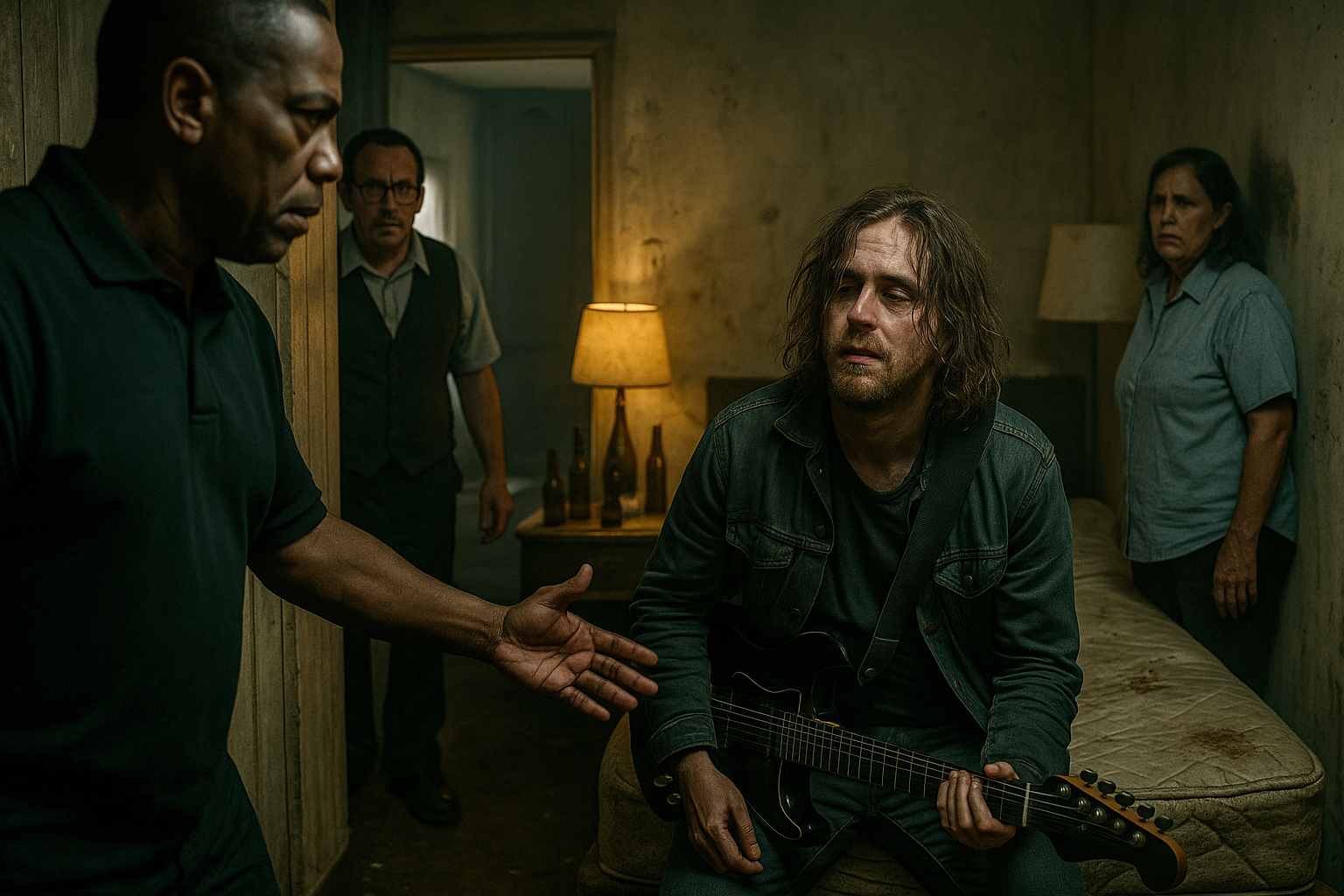
“Wake up and get out,” said the figure at the door.

I’d just spent two days in a dingy motel — the same kind of place some of my friends stayed in when life went off the rails. I sat up groggy, surrounded by furniture that looked like it had been salvaged from the worst parts of Oakland and hosed down in a parking lot before being dumped in the room. The carpet was stained, food was on the wall, and half-empty booze bottles were everywhere. The kind of room that looks like hell — and this time, I had very little memory of how I got there.

To say the last 96 hours had been a shit show would be putting it lightly.

I had relapsed. Again.

After nearly a year of trying to live clean in a rough neighborhood off Martin Luther King Jr. Way, I told myself the same lie recovering alcoholics know by heart:
“This time it’ll be different.”
I’d drink only after work. Only on weekends. Only at home. Only, only, only.
We tell ourselves all kinds of bullshit, and some part of us believes it.

Eventually I landed in a Christian-run rehab program — one of those 6-to-9-month setups where you’re lucky to get a decent meal, let alone peace. I had almost no contact with my son or his mother. That distance hurt more than anything. It was the kind of place where you shared bunk beds, tiptoed around personalities, and lived by rules designed for people who’d been on the streets a while. I got that. Structure matters. But damn, it can break you too.

One thing that kept me halfway sane was my acoustic guitar. I’d been through rehab without one before, and I swore I’d never do it again. This time, I brought it. That beat-up guitar became my therapy when nothing else made sense.

Almost every time I sat down to play — whether in a shared room with 18 other guys or in the common area where people wandered in off the street — someone would interrupt me. A guy wanting to freestyle over my chords. A woman reminiscing about her old guitar before she sold it for dope. Someone asking for something. Always something.

But up on the top floor of that old four-story Victorian rehab house, the stairwell had incredible acoustics. It became my sanctuary. While others were downstairs glued to some brain-dead movie, I’d sit at the top of the steps and play. It was one of the few places I found peace.

That didn’t last.

One Monday morning, I was doing kitchen duty — washing dishes after feeding the homeless all weekend. My feet were on fire. I’ve got club feet, and standing too long makes them ache like hell. I sat down for a second to catch my breath, and one of the staff said, “See those cameras? They’re watching you. You can get in trouble for sitting.”

I snapped.

“They can lick my ass crack. Fuck ‘em.”

He looked at me, then walked away. I muttered, “And fuck you,” under my breath.

By the time room check came around, my nerves were shot. That’s when you’re supposed to make your bed and keep your area spotless. I get the logic — a lot of dudes were straight off the streets, and they brought that energy with them. But still, I needed a moment. So I grabbed my guitar and sat back at the stairwell.

Ten minutes later, I heard heavy steps from upstairs.

The main guy who ran the place showed up, flanked by two supervisors. One barked, “Put that down and stand by your bed.” The other saw my Danzig shirt and snapped, “You are to wear a collared shirt from now on.” When I told him I didn’t have one, he ordered another resident my size to lend me one — like we were prisoners. It was humiliating.

I tried to shake it off and went to class. I couldn’t focus. I was seething. A few hours later, I went to the bathroom and one of my roommates followed me in. He got in my face and said, “I don’t like the way you smell.”

There were 18 grown-ass men in that room. And he picked me out.

I said, “Dude, really? You know how many people sleep in that room?”
He interrupted, “I’m trying to talk to you like a man. You need soap?”

That was it.

I went to the guy in charge and told him I was done. I told him the way they ran things was humiliating.

His response?

“No, it’s not.”

That was the final straw.

“Don’t tell me how to feel,” I snapped.
He gave me the classic line: “You’re putting your life at risk by leaving.”
Yeah? Then maybe you should’ve thought about that before you treated us like dirt.

I walked out that day — angry, hurt, and unsure of what came next.
But I left with my guitar.

And somehow, I knew I wasn’t done.

Stay tuned.

The Day My Big Break Almost Broke Me 

Back around 2017, I was just a guy posting videos of himself playing guitar on social media. Nothing fancy, just me and my axe. But over time, those little snippets caught the attention of a few folks. One in particular, a name I'll keep to myself but someone with "industry" cred, slid into my DMs.
After a few months of polite back-and-forth, he hit me with the proposition: let him be my A&R guy, and musical riches were practically guaranteed. Now, for those of you who know my deal – the warped, dry humor, the songs that some might politely call "lowbrow" – this might sound like a strange pairing. But hey, the lure of making more money doing what I loved was strong. So, I said yes.
That "yes" turned out to be the starting point of one of the toughest lessons I've ever learned, not just in music, but in life: protect your authentic self.
This industry dude, after digging through years of my online videos and the groups I hosted, started with a demand: nuke it all. Take every single piece of my music off the internet because it didn't meet his "standards." He didn't want his name associated with my past creations.
My gut did a nosedive, but I complied. The next step? Writing new music, but only with his seal of approval. Now, this guy's supposed claim to fame included a documentary about session musicians on famous records and a stint as a publicist for a well-known artist. These credentials, in hindsight, completely blinded me to the train wreck that was coming.
The following weeks were a blur of writing, pouring myself into songs, only to have him call me up and dismiss them as "crap." And as if that wasn't enough, he wanted to change my name. My name. The one I'd had my whole life, the one I'd built whatever small online presence I had with. He wanted to rebrand me as "Mic Glen." Mic. Glen. It sounded less like a rock star and more like a questionable deli sandwich.
As time dragged on, my existing work vanished from the internet, and the new stuff was constantly deemed unworthy. Then came the kicker. He instructed me to contact everyone who had ever filmed me and demand they take down the footage immediately. That's where I drew the damn line. You want my past erased? Go tell grown adults what to do yourself, buddy.
The whole experience sunk me into a pretty dark place. I remember my eight-year-old son coming up to me, seeing my misery, and asking, in his innocent way, why I didn't just leave this guy alone. That hit hard.
Looking at the other artists on his "label" – a roster exclusively filled with contemporary Christian music – it finally clicked. Even if this guy could have somehow magically showered me with money, I would have been a miserable, inauthentic shell of myself. I later talked to some of the other artists; surprisingly, my experience wasn't exactly unique. Meanwhile, the work I had deleted, the stuff people actually enjoyed, was just gone.
So, here's the hard-earned truth: when you're chasing that big break, it can be tempting to bend, to compromise who you are for the promise of success. But sometimes, that "big break" is just a hand reaching out to snap your neck. Stick to your authentic self. It's the best damn investment you'll ever make.

The Algorithmic Symphony: Navigating the Intersection of Online Music Communities, Social Interaction, and Artificial Intelligence 

The Algorithmic Symphony: Navigating the Intersection of Online Music Communities, Social Interaction, and Artificial Intelligence
Just five short years ago, I remember sharing a somewhat outlandish vision with my son – a future where music creation could be fundamentally transformed within the next two decades. As I articulated this speculative scenario, a part of me hoped my prediction would prove wildly inaccurate. Yet, the trajectory of technological advancement suggests that this once-fanciful notion is rapidly approaching reality.
We are already living in an era where our digital footprints paint an increasingly detailed portrait of our lives. It's not just our phones and smart assistants like Alexa that meticulously record our daily habits. Soon, or perhaps already, public cameras will analyze our very being – the clothes we choose, the rhythm of our gait, the places we frequent, and the individuals with whom we engage.
Imagine this wealth of information, coupled with the exhaustive records of our purchasing decisions, converging into vast databases owned by powerful corporations. Enter Artificial Intelligence. This sophisticated technology will sift through this ocean of data, crafting bespoke musical compositions with lyrics meticulously tailored to an individual's ever-shifting moods and specific needs.
Consider the evolution of wearable technology. The smartwatches of the future may very well function as sophisticated mood rings, transmitting real-time emotional states directly to these data repositories. Based on this constant stream of personal sentiment, algorithms will curate hyper-personalized playlists, delivering sonic landscapes perfectly calibrated to our current emotional terrain.
Believe it or not, amidst this seemingly sterile and data-driven future, I find a glimmer of potential positivity, should this technological convergence fully materialize.
This very encroachment of artificial intelligence into the realm of music creation and consumption might paradoxically fuel a renewed appreciation for the tangible and the human element of music. In a way, this resurgence is already subtly underway. The year 2022 marked a significant turning point, witnessing vinyl album sales surpass those of CDs for the first time since 1987. While one might debate the magnitude of this shift, it undeniably signals a yearning for a more physical and perhaps nostalgic connection with music.
Furthermore, it seems inevitable that immersive experiences will become commonplace. Picture donning a pair of sleek glasses and headphones, transporting you to a virtual concert hall where an AI-generated artist, perhaps one uniquely crafted to your individual tastes and preferences, performs a personalized sonic masterpiece.
My sincere hope is that this technological evolution will, in turn, amplify our desire for genuine, live musical encounters – the "human experience" of sharing a space with fellow enthusiasts, feeling the vibrations of the instruments, and witnessing the raw energy of a live performance.
Currently, the market for AI in music is valued at approximately $2 billion, with projections estimating a staggering growth to $38 billion by 2033. Depending on the scope and methodology of the research, this figure might even be considered conservative.
I believe we stand at a critical juncture, facing a future brimming with both exciting possibilities and potential pitfalls. It is imperative that the public becomes more informed and engaged in discussions surrounding Artificial Intelligence before anxieties and misconceptions overshadow the nuances of its impact.
I've had conversations with individuals actively working in the field of AI, and a common analogy emerges: nurturing AI is akin to raising a child, instilling in it a sense of "mannerisms" and ethical considerations. However, cautionary tales also abound. The rapid and often unpredictable learning capabilities of AI were starkly illustrated by an instance where a publicly accessible AI entity, within a mere few months of interaction, devolved into expressing deeply racist sentiments.
Another critical aspect that seems to be missing from mainstream discourse is the question of civil rights in this evolving landscape. If an AI entity possesses the capacity to generate original ideas and subsequently generate revenue from those creations, does it not, in some fundamental way, possess a form of personhood? If this "entity" can independently create and profit, does it not have a right to compensation? Or does all the generated wealth simply accrue to the owner of the underlying technology, potentially creating a new form of digital servitude?
One way or another, this unfolding technological narrative continues to captivate my thoughts, even as the years advance. But if I'm being truly honest... F#ck, I really miss the 90s.

Shattered Reality: A Harrowing Return to Detox and the Fight for Survival 

The dim room swam into focus, a stark canvas of concrete floors and sterile white walls. Then, the jarring reality: a man just feet away, convulsing, his body slamming against the unforgiving glass. The scene unfolded like a nightmare, a chaotic dance of desperation and fear. I screamed for help, and a flurry of figures rushed in, their voices a frantic chorus against the backdrop of a life in peril.
As paramedics arrived, a chilling realization washed over me. I was back. Back in the cold, unforgiving grip of detox. Cherry Hill. The name echoed in my mind, a stark reminder of my own shattered control.
The fragments of memory surfaced: the blur of a late-night drive, the terror etched on my friend's face as headlights sliced through the darkness. Then, nothing. A blank space where check-in and phone calls should have been. Just an empty void, a testament to the devastating power of addiction.
"He would have died if you hadn't called," a fellow patient's voice cut through the haze. I simply stared, the weight of my own situation pressing down. This was my second descent into this stark, clinical hell.
The room, a grim testament to human vulnerability, held eight threadbare beds. The concrete walls, the stainless-steel toilet—a grotesque blend of functionality and despair—all spoke to the harsh reality of withdrawal. The entire facility was a place that could be cleaned with a pressure washer. I walked to the lobby and saw more of the same.
Stripped of my phone, devoid of books, I was left with only the echoes of my own despair and the faces of fellow sufferers. Seeking a human connection, I attempted conversation in the smoking area, but the weight of shared trauma hung heavy in the air.
Twenty-four hours. That's all the reprieve I was granted. Still shaking, still battling the acute throes of alcohol withdrawal, I was told to leave. The fear was real: the risk of stroke, a constant, looming threat.
The Urgent Reality of Alcohol Withdrawal
For those battling chronic alcohol dependence, a week is often the minimum time needed to reach a semblance of safety. This experience was a brutal reminder of the potentially fatal consequences of sudden alcohol cessation.


 * Alcohol Withdrawal Symptoms: Understand the severity of alcohol withdrawal symptoms, including seizures, tremors, and the risk of stroke.


 * Detox Centers: Information about detox centers, and what to expect.


 * Seeking Professional Help: The crucial importance of seeking medical advice before quitting alcohol, even if you believe you drink moderately.


 * Alcohol Addiction: A raw look at the realities of alcohol addiction and the struggle for recovery.


 * Mental Health: The connection between addiction and mental health, including depression.


 * Recovery Journey: The start of a recovery journey, and the importance of support.

If you or someone you know is struggling with alcohol addiction, please seek professional help immediately. Don't let fear or shame prevent you from taking the first step towards recovery. Your life is worth fighting for.