Viewing: Real Stories of Rehab - View all posts

A New Relationship with Recovery 


A New Relationship with Recovery
by Mike Glendinning

I feel like I have a new relationship with recovery.

I’ve spent the last 20 years going in and out of rehab centers. I’ve had long stretches of sobriety, and I’ve had blackout moments that could fill a book. For a long time, when I wasn’t drinking, I missed it. I missed the parties. I missed the bar talk, the laughter, the chaos that felt like connection. But what I never remembered was the craving—the desperation that came before that first drink.

And once I started drinking again?

I missed being sober.

It took me all these years to realize I don’t drink like a normal person. I’ve seen normal people have half a beer, put it down, and not touch another one for two years. Me? I get one sip, and I’m already on the edge of the next run.

Some people waste a weekend. I’ll waste a whole damn month… if I’m lucky.

Alcohol to me is like being in a relationship with a crazy ex you know is bad for you. Yeah, you remember the wild nights, the good laughs, the stories. But you also start to remember the screaming, the manipulation, the blackout calls that had nothing to do with you but made you feel like shit anyway. That’s alcohol. It seduces, then destroys.

And when I really think about it—drinking never gave me anything good. Not a thing.
Sober? I’ve got music. Connection. Sanity. Faith. Purpose.
There’s no contest.

Right now, I’m in a room in Oakland, in a sober living house. The window’s open. Outside, people are partying—or at least trying to. Smoking weed, meth, drinking all day like it’s freedom. From up here, it looks like they’re having the time of their lives. But I know what that illusion really costs.

I look down and see the Store Club—a place I used to play. A place I have memories in. Oakland is full of those for me. The fake beauty of addiction, and the hard truth of where it always ends up.

And still… I love this city.
Because this is where I found out who I really fucking am.

Looking back, I don’t think I wasted my life.
I think this was all part of God’s plan.
The drinking. The losing. The trying.
The falling again.
The praying.
The surrender.

Will I drink again?

I sure the fuck hope not.

“Fuck This Shit”: Rehab, Guitar, and the Stairwell That Saved My Soul 

By Mike Glendinning — www.glendinningmike.com

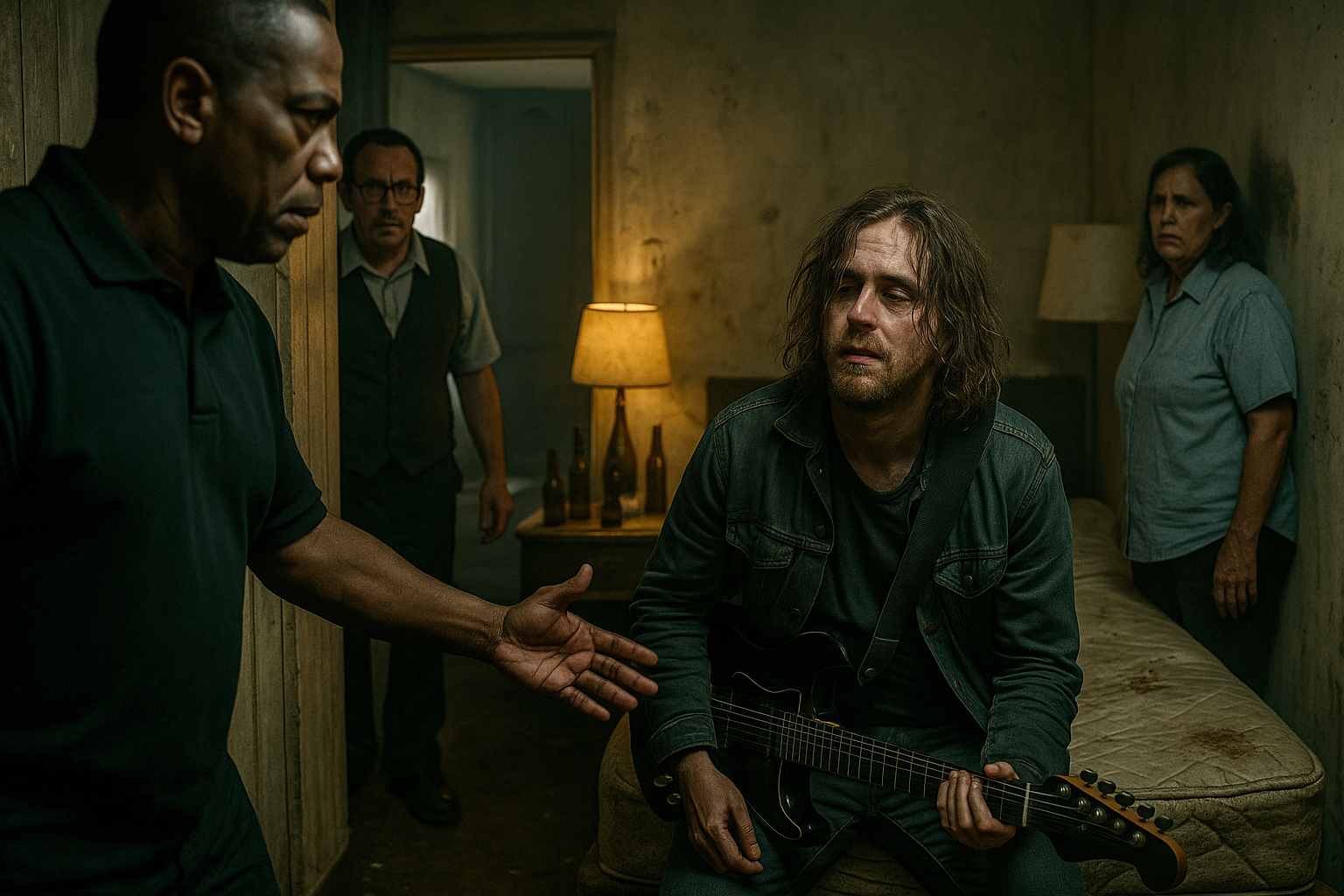
“Wake up and get out,” said the figure at the door.

I’d just spent two days in a dingy motel — the same kind of place some of my friends stayed in when life went off the rails. I sat up groggy, surrounded by furniture that looked like it had been salvaged from the worst parts of Oakland and hosed down in a parking lot before being dumped in the room. The carpet was stained, food was on the wall, and half-empty booze bottles were everywhere. The kind of room that looks like hell — and this time, I had very little memory of how I got there.

To say the last 96 hours had been a shit show would be putting it lightly.

I had relapsed. Again.

After nearly a year of trying to live clean in a rough neighborhood off Martin Luther King Jr. Way, I told myself the same lie recovering alcoholics know by heart:
“This time it’ll be different.”
I’d drink only after work. Only on weekends. Only at home. Only, only, only.
We tell ourselves all kinds of bullshit, and some part of us believes it.

Eventually I landed in a Christian-run rehab program — one of those 6-to-9-month setups where you’re lucky to get a decent meal, let alone peace. I had almost no contact with my son or his mother. That distance hurt more than anything. It was the kind of place where you shared bunk beds, tiptoed around personalities, and lived by rules designed for people who’d been on the streets a while. I got that. Structure matters. But damn, it can break you too.

One thing that kept me halfway sane was my acoustic guitar. I’d been through rehab without one before, and I swore I’d never do it again. This time, I brought it. That beat-up guitar became my therapy when nothing else made sense.

Almost every time I sat down to play — whether in a shared room with 18 other guys or in the common area where people wandered in off the street — someone would interrupt me. A guy wanting to freestyle over my chords. A woman reminiscing about her old guitar before she sold it for dope. Someone asking for something. Always something.

But up on the top floor of that old four-story Victorian rehab house, the stairwell had incredible acoustics. It became my sanctuary. While others were downstairs glued to some brain-dead movie, I’d sit at the top of the steps and play. It was one of the few places I found peace.

That didn’t last.

One Monday morning, I was doing kitchen duty — washing dishes after feeding the homeless all weekend. My feet were on fire. I’ve got club feet, and standing too long makes them ache like hell. I sat down for a second to catch my breath, and one of the staff said, “See those cameras? They’re watching you. You can get in trouble for sitting.”

I snapped.

“They can lick my ass crack. Fuck ‘em.”

He looked at me, then walked away. I muttered, “And fuck you,” under my breath.

By the time room check came around, my nerves were shot. That’s when you’re supposed to make your bed and keep your area spotless. I get the logic — a lot of dudes were straight off the streets, and they brought that energy with them. But still, I needed a moment. So I grabbed my guitar and sat back at the stairwell.

Ten minutes later, I heard heavy steps from upstairs.

The main guy who ran the place showed up, flanked by two supervisors. One barked, “Put that down and stand by your bed.” The other saw my Danzig shirt and snapped, “You are to wear a collared shirt from now on.” When I told him I didn’t have one, he ordered another resident my size to lend me one — like we were prisoners. It was humiliating.

I tried to shake it off and went to class. I couldn’t focus. I was seething. A few hours later, I went to the bathroom and one of my roommates followed me in. He got in my face and said, “I don’t like the way you smell.”

There were 18 grown-ass men in that room. And he picked me out.

I said, “Dude, really? You know how many people sleep in that room?”
He interrupted, “I’m trying to talk to you like a man. You need soap?”

That was it.

I went to the guy in charge and told him I was done. I told him the way they ran things was humiliating.

His response?

“No, it’s not.”

That was the final straw.

“Don’t tell me how to feel,” I snapped.
He gave me the classic line: “You’re putting your life at risk by leaving.”
Yeah? Then maybe you should’ve thought about that before you treated us like dirt.

I walked out that day — angry, hurt, and unsure of what came next.
But I left with my guitar.

And somehow, I knew I wasn’t done.

Stay tuned.

Shattered Reality: A Harrowing Return to Detox and the Fight for Survival 

The dim room swam into focus, a stark canvas of concrete floors and sterile white walls. Then, the jarring reality: a man just feet away, convulsing, his body slamming against the unforgiving glass. The scene unfolded like a nightmare, a chaotic dance of desperation and fear. I screamed for help, and a flurry of figures rushed in, their voices a frantic chorus against the backdrop of a life in peril.
As paramedics arrived, a chilling realization washed over me. I was back. Back in the cold, unforgiving grip of detox. Cherry Hill. The name echoed in my mind, a stark reminder of my own shattered control.
The fragments of memory surfaced: the blur of a late-night drive, the terror etched on my friend's face as headlights sliced through the darkness. Then, nothing. A blank space where check-in and phone calls should have been. Just an empty void, a testament to the devastating power of addiction.
"He would have died if you hadn't called," a fellow patient's voice cut through the haze. I simply stared, the weight of my own situation pressing down. This was my second descent into this stark, clinical hell.
The room, a grim testament to human vulnerability, held eight threadbare beds. The concrete walls, the stainless-steel toilet—a grotesque blend of functionality and despair—all spoke to the harsh reality of withdrawal. The entire facility was a place that could be cleaned with a pressure washer. I walked to the lobby and saw more of the same.
Stripped of my phone, devoid of books, I was left with only the echoes of my own despair and the faces of fellow sufferers. Seeking a human connection, I attempted conversation in the smoking area, but the weight of shared trauma hung heavy in the air.
Twenty-four hours. That's all the reprieve I was granted. Still shaking, still battling the acute throes of alcohol withdrawal, I was told to leave. The fear was real: the risk of stroke, a constant, looming threat.
The Urgent Reality of Alcohol Withdrawal
For those battling chronic alcohol dependence, a week is often the minimum time needed to reach a semblance of safety. This experience was a brutal reminder of the potentially fatal consequences of sudden alcohol cessation.


 * Alcohol Withdrawal Symptoms: Understand the severity of alcohol withdrawal symptoms, including seizures, tremors, and the risk of stroke.


 * Detox Centers: Information about detox centers, and what to expect.


 * Seeking Professional Help: The crucial importance of seeking medical advice before quitting alcohol, even if you believe you drink moderately.


 * Alcohol Addiction: A raw look at the realities of alcohol addiction and the struggle for recovery.


 * Mental Health: The connection between addiction and mental health, including depression.


 * Recovery Journey: The start of a recovery journey, and the importance of support.

If you or someone you know is struggling with alcohol addiction, please seek professional help immediately. Don't let fear or shame prevent you from taking the first step towards recovery. Your life is worth fighting for.